We interrupt our regularly scheduled program to bring you this breaking sociopolitical rant.
This past winter, in the immediate wake of an inspiring, hopeful, historically unprecedented act of political esprit de corps, untold thousands of New Yorkers made the dispiriting conscious choice to literally treat their city like shit.
When the snow stubbornly carpeting New York in January and February finally—finally—began to recede, I was shocked to discover the property of my Bronx apartment complex studded with dog turds. Call me naïve, but I couldn’t believe my neighbors would disrespect our shared home like this.
The scene was no different around the rest of the neighborhood: the sidewalks and curbsides a minefield of thawing scat. When I would text friends in the other boroughs to see how they were surviving the long, cold winter, the response was some variation of, “Fine—except for hopscotching around all the dog shit.” The problem was so pervasive, it was covered on the local news:
Frustrated New Yorkers took to Reddit to vent. They posted personal appeals for decency on scaffolding poles and lampposts:
Photos I snapped around my Bronx neighborhood
All of which reminded me of a scene from State of Grace (1990), a movie I’d already been thinking about in light of St. Patrick’s Day, in which Jackie Flannery (Gary Oldman) laments the yuppie gentrification driving the Irish out of Hell’s Kitchen:
Oldman as Jackie and Sean Penn as Terry in “State of Grace”
“It never used to be that way. Used to be you dropped a cone, you could pick it up and finish it.” Hear, hear.
At last month’s StokerCon, I was invited to participate on a panel about the subject of ecohorror—that is, horror fiction with environmental themes—titled “Eco-Horror: Is Nature Trying to Kill Us?”
As it was proposed to me, the panel would “discuss some of the early examples of ecohorror in literature, like Algernon Blackwood’s The Willows, and trace those influences on today’s ecohorror classics. We will also seek to define the subgenre more clearly through our discussion: Is ecohorror merely a horror story set in the woods? Is it when nature turns against humanity? Or is it when the story carries a message about humanity’s impact on the ecosystem?”
The panel was moderated by author Marc E. Fitch (Dead Ends, Boy in the Box, Paradise Burns). My fellow participants included authors Christopher Hawkins (Suburban Monsters, Downpour, I Contain Multitudes), Raymonde Chira (“Hells Shells” from The Off-Season: An Anthology of Coastal New Weird), and Brian J. Cummings (Dark Concepts).
We had a lively conversation that got very enthusiastic feedback. Given this blog’s emphasis on narrativity and environmentalism, I have reproduced Marc’s questions below, along with my responses only.
When I was first approached about moderating this panel, my friend wrote to me saying my novel Boy in the Box is “hard ecohorror.” Boy in the Box is about three friends who have to return to the site of a hunting accident to move a body and are stalked by a demonic presence. Probably half the novel is set in the woods, but I had never thought of it as “ecohorror.” That term always struck me as something different, and that is my question to all of you: Is ecohorror simply horror that takes place in the woods or involves animals trying to kill us like Cujo or Jaws or something? Or does the label of ecohorror point to something more, a message in the work?
More often than not, I would say ecohorror is going to deal with our relationship to animals and insects or to ecosystems writ large.
While “ecohorror” is certainly a broad-umbrella term, it can usually be applied to any story that explores or exploits a fear of nature or a fear for nature.
Jurassic Park is a fear of nature story: “Oh, my God—what have we unleashed?” In bringing back dinosaurs, have we arrogantly ensured our own extinction…?
Conversely, the plot of The Lost World is animated by a fear for nature, because you’ve got Jeff Goldblum trying to prevent the capitalistic exploitation of the dinosaurs. In the sequel, it’s the capitalists who are the real monsters, not the dinosaurs.
Sorta gives new meaning to the term “fossil fuels,” eh?
Jaws is, in many respects, a rather ecophobic movie, with the great white representing a threat to Amity Island’s capitalistic prosperity; the mayor very explicitly states, “Hey, we’re a summer town, and we need summer dollars.” The alternative is “being on welfare all winter,” as Quint bluntly warns, with the implied shame of living off the state. The filmmakers of Jaws—and, by extension, the audience—are rooting for capitalism, not nature, to triumph.
A year after Jaws, Dino De Laurentiis produced a cash-grab knockoff called Orca, about a killer whale out for revenge against Richard Harris for killing its pregnant mate. Even though Orca is considered an inferior film and hasn’t enjoyed nearly the same cultural longevity as Jaws, it demonstrates a compassion for nature that is entirely absent in Jaws, which unambiguously sides with the island’s capitalists over its marine life.
Even the resident marine biologist, Richard Dreyfuss, who professes to love sharks, wants the shark dead! He never once makes an argument in defense of the shark’s right to exist the way Jeff Goldblum so eloquently advocates on behalf of Mother Nature in the Jurassic Park films. Instead, he says, “Well, it’s just an eating machine and it isn’t going to stop until it’s killed.” At no point does he say, “That’s just a risk we assume when we encroach on its natural habitat.” Quite notably, Hooper is established as a character who grew up privileged, so there are clearly limits to his empathy.
Let’s play Ten for Ten! To commemorate the ten-year anniversary of this blog, which launched on June 26, 2014, here’s an appreciation for ten of my formative cinematic influences—an examination of why these movies resonated with me when I first saw them, and how they permanently informed my aesthetic tastes and creative sensibilities. This post is presented in three installments.
“Under the Influence, Part 1” informally ponders through personal example how an artist develops a singular style and voice all their own, and offers an analysis of Quentin Tarantino’s essay collection Cinema Speculation, the auteur’s critical look at the movies of the ’70s that inspired him.
In “Under the Influence, Part 2,” I spotlight five films from my ’80s childhood that shaped my artistic intuition when at its most malleable.
And in “Under the Influence, Part 3,” I round out the bill with five selections from my ’90s adolescence, the period during which many of the themes that preoccupy me crystalized.
Given that my childhood coincided with what Quentin Tarantino terms “the miserable eighties”—that decade of “middle-of-the-road successful films”1 during which “likeability was everything”2—the following ten cinematic specimens that impressed so notably upon my nascent imagination, accordingly, span the years 1978 through 1993.
Before we dive in, let’s stipulate what this digest isn’t. These are not what I consider the Best Movies Ever, or even the best movies of their era, neither of which I am particularly qualified to judge.
Furthermore, they are not necessarily even my favorite movies, merely the ones that made a meaningful, lasting, and demonstrable impression on me, and whose DNA has (repeatedly) found their way into my own work.
Nor does this cover my literary or musical influences, because, as Geddy Lee suggests, the project of tracing this stuff ain’t easy; it took a surprising amount of rumination to settle upon the ten selections studied here. (None of them are particularly obscure; if you haven’t seen all ten, you’ve at least heard of them.)
It must also be noted I am uncomfortably aware of how, well, white all my chosen case studies are. The filmmakers and screenwriters are nigh exclusively straight white men, with the known exceptions of Joel Schumacher, Leslie Newman, and Janice Fischer.
What’s more, every protagonist across the board is a straight white male, several of them either explicitly or implicitly Irish American, at that. Boys like me were very well represented in popular media back then—still are—as there are precious few actors of color to be found in any these productions, and, in those rare instances, always in small or supporting roles.
These cinematic influences are all unambiguously predicated on a heteronormative worldview and a white male perspective. I acknowledge that.
But… as much as they (mostly) glorify white boys, they all (save one) speak to at least one of two themes that have fascinated me throughout my life, and which are the dominant subjects of my own fiction.
The first is the complicated dynamic between fathers/men and sons/boys.
The second: the special bond of boyhood friendship, and how boys often look to each other for the emotional support they don’t get from their parents.
Men’s relationships with their fathers and their friends was a central theme of “Ted Lasso”
The stories I respond to and the stories I write are, for the most part, about straight white males. But I consciously seek to eschew the reductive paradigms favored by Hollywood—notably the solitary antihero and middle-aged manchild—in favor of men who are competent but not superheroic, compassionate but not saintly, flawed but not cruel, and definitely not proudly antisocial, brazenly irresponsible, or comfortably violent.
We have spent the past half-decade wrestling with ideas of gender and privilege, attempting to challenge the old stereotypes and power structures. These conversations should have been an opportunity to throw out the old pressures and norms of manhood, and to help boys and men be more emotionally open and engaged. But in many ways this environment has apparently had the opposite effect—it has shut them down even further. . . .
Perhaps it’s not surprising that in the grip of the culture wars, caring about boys has become subtly coded as a right-wing cause, a dog whistle for a kind of bad-faith politicking. Men have had way more than their fair share of our concern already, the reasoning goes, and now it’s time for them to pipe down. But for boys, privilege and harm intertwine in complex ways—male socialization is a strangely destructive blend of indulgence and neglect. Under patriarchy, boys and men get everything, except the thing that’s most worth having: human connection.
Silencing or demonizing boys in the name of progressive ideals is only reinforcing this problem, pushing them further into isolation and defensiveness. The prescription for creating a generation of healthier, more socially and emotionally competent men is the same in the wider political discourse as it is in our own homes—to approach boys generously rather than punitively. We need to acknowledge boys’ feelings, to talk with our sons in the same way we do our daughters, to hear them and empathize rather than dismiss or minimize, and engage with them as fully emotional beings.
The storytellers could contribute to a meaningful shift of the cultural mindset if we summoned the moral imagination to refuse to further represent masculinity as a binary (and compulsory) choice between two equally oppressive and simplistic models of social posturing and self-identity—either he-man or Peter Pan—and dared to instead portray boys and men as human beings of nuanced emotion, as capable of expressing sympathy as they are deserving of receiving it.
Now more than ever, we need thoughtful, responsible fiction by men about men—stories that explore masculinity and manhood without invoking the same tired, narrow, noxious archetypes of tough-guy antiheroes who “play by their own rules” and stunted-adolescent slackers for whom rules, the mere acknowledgment of let alone adherence to, are the stuff of “adulting,” and fuck that shit. Such prosocial, aspirational fiction might very well be called helpful exercises in wish fulfillment. That’s what I’ve called for, and what I strive to produce myself.
Now let’s look, in mostly linear order, at the films that shaped my tastes and style, starting with the first five (of ten) selections. Click on any of the links below to jump directly to that particular subheading and its corresponding treatise:
Let’s play Ten for Ten! To commemorate the ten-year anniversary of this blog, which launched on June 26, 2014, here’s an appreciation for ten of my formative cinematic influences—an examination of why these movies resonated with me when I first saw them, and how they permanently informed my aesthetic tastes and creative sensibilities. This post is presented in three installments.
“Under the Influence, Part 1” informally ponders through personal example how an artist develops a singular style and voice all their own, and offers an analysis of Quentin Tarantino’s essay collection Cinema Speculation, the auteur’s critical look at the movies of the ’70s that inspired him.
In “Under the Influence, Part 2,” I spotlight five films from my ’80s childhood that shaped my artistic intuition when at its most malleable.
And in “Under the Influence, Part 3,” I round out the bill with five selections from my ’90s adolescence, the period during which many of the themes that preoccupy me crystalized.
It takes an unholy degree of time and stamina to write a book. Consequently, it’s advisable to have a really good reason to take a given project on—then see it through to the finish line. Before typing word one of a new manuscript, it behooves us to ask (and answer): Why is this project worth the herculean effort required to bring it into existence?
I wrote my debut novelThe Dogcatcher (2023) for the most elemental of motives: I ached for the kind of bygone horror/comedies on which I’d come of age in the ’80s, an era that produced such motley and memorable movies as An American Werewolf in London (1981), The Evil Dead (1981), Gremlins (1984), Ghostbusters (1984), The Witches of Eastwick (1987), The Lost Boys (1987), The Monster Squad (1987), The ’Burbs (1989), and Tremors (1990). Where have those kinds of movies gone? I wondered.
Hollywood, to be fair, hadn’t stopped making horror/comedies, it only long since stopped making them with any panache. I have spent many a Saturday night over the past decade in a binge-scrolling malaise, surfing numbly through hundreds of viewing options on Netflix or Prime or Hulu or whatever, when suddenly my inner adolescent’s interest is piqued—as though I were back at the old video store and had found a movie right up my alley.
I certainly sensed the stir of possibility in Vampires vs. the Bronx (2020), about a group of teenagers from my hometown battling undead gentrifiers. Night Teeth (2021), featuring bloodsuckers in Boyle Heights, seemed equally promising. And Werewolves Within (2021) is set in a snowbound Northeastern United States township already on edge over a proposed pipeline project when its residents find themselves under attack by a werewolf.
“Vampires vs. the Bronx” (2020) seemed like the perfect mix of Gen X–era throwback and Gen Z–era social commentary
All of a sudden, I felt like that sixteen-year-old kid who saw the one-sheet for Buffy the Vampire Slayer (1992) while riding the subway to work—“She knows a sucker when she sees one,” teased the tagline, depicting a cheerleader from the neck down with a wooden stake in her fist—and knew he was in for a good time at the cinema.
No such luck. Vampires vs. the Bronx, in an act of creative criminality, pisses away a narratively and thematically fertile premise through flat, forgettable execution.
Night Teeth, meanwhile, answers the question: How about a movie set in the same stomping ground as Blade (1998)—inner-city L.A., clandestine vampiric council calling the shots—only without any of its selling-point stylistics or visual inventiveness?
And Werewolves Within establishes an intriguing environmental justice subplot the screenwriter had absolutely no interest in or, it turns out, intention of developing—the oil pipeline isn’t so much a red herring as a dead herring—opting instead for a half-assed, who-cares-less whodunit beholden to all the standard-issue genre tropes.
Faced with one cinematic disappointment after another, it seemed the only way to sate my appetite for the kind of horror/comedy that spoke to me as a kid was to write my own.
On the subject of kids—specifically, stories about twelve-year-old boys—I haven’t seen one of those produced with any appreciable measure of emotional honesty or psychological nuance since Rob Reiner’s Stand by Me (1986), based on Stephen King’s 1982 novella The Body. That was forty years ago!
Storytellers know how to write credible children (E.T. the Extra-Terrestrial, Home Alone, Room), and they know how to write teenagers (The Outsiders, Ferris Bueller’s Day Off, Clueless), but preadolescent boys are almost invariably reduced to archetypal brushstrokes (The Goonies, The Sandlot, Stranger Things). The preteen protagonists of such stories are seldom made to grapple with the singular emotional turbulence of having one foot in childhood—still watching cartoons and playing with action figures—and the other in adolescence—beginning to regard girls with special interest, coming to realize your parents are victims of generational trauma that’s already in the process of being passed unknowingly and inexorably down to you.
For all of popular culture’s millennia-long fixation on and aggrandizement of the heroic journey of (usually young) men, our commercial filmmakers and storytellers either can’t face or don’t know how to effectively dramatize the developmental fulcrum of male maturation. George Lucas’ experimental adventure seriesThe Young Indiana Jones Chronicles (1992–1996) sheds light on Indy’s youth from ages eight through ten (where he’s portrayed by Corey Carrier) and then sixteen through twenty-one (Sean Patrick Flanery); the complicated messiness of pubescence, however, is entirely bypassed. Quite notably, those are the years in which Indy’s mother died and his emotionally distant father retreated into his work—formative traumas that shaped, for better and worse, the adult hero played by Harrison Ford in the feature films.
Lucas’ elision seems odd to me—certainly a missed creative opportunity1—given that twelve-going-on-thirteen is the period of many boys’ most memorable and meaningful adventures. King and Reiner never forgot that, and neither did I, hence the collection of magical-realism novellas I’m currently writing that explore different facets of that transitory experience: going from wide-eyed wonder to adolescent disillusionment as a result of life’s first major disappointment (Spex); being left to navigate puberty on your own in the wake of divorce (The Brigadier); struggling to understand when, how, and why you got socially sorted at school with the kids relegated to second-class citizenry (H.O.L.O.).
This single-volume trilogy, I should note, isn’t YA—these aren’t stories about preteens for preteens. Rather, they are intended, like The Body/Stand by Me before them, as a retrocognitive exercise for adults who’ve either forgotten or never knew the experience of being a twelve-year-old boy to touch base with that metamorphic liminality in all of its psychoemotional complexity. They’re very consciously stories about being twelve as reviewed from middle-aged eyes.
As I’ll demonstrate in “Part 2” and “Part 3,” both that WIP and The Dogcatcher take inspiration—narratively, thematically, aesthetically, referentially—from the stories of my youth, the books and movies that first kindled my imagination and catalyzed my artistic passions.
Ah, it’s that magical time of year! When the Hudson hawk nips at the nose, and the skyline over the New Jersey Palisades bruises by midafternoon. When chimney smoke from private houses spices the air, and strings of colored lights adorn windows and fire escapes. And, of course, when the Internet engages in its annual bullshit debate as to whether perennial holiday favorite Die Hard, currently celebrating its thirty-fifth anniversary, is a Christmas movie. And since “bullshit debates” are my brand…
In fourth grade, I scored what was, by 1980s standards, the holy grail: a best friend with HBO. Over the following five years, I slept over at his house every weekend, where we watched R-rated action movies into the night. Whatever HBO was showing that week, we delighted in it, no matter how idiotic (Action Jackson) or forgettable (Running Scared). For a pair of preadolescent boys, that Saturday-night cinematic grab bag abounded with illicit wonders.
Much as we enjoyed those movies, though, they were for the most part—this isn’t a criticism—ephemeral crap. We howled at their profane jokes and thrilled to their improbable set pieces, but seldom if ever revisited any of them (Beverly Hills Cop [1984] and its sequel [1987] being a rare exception), and certainly none inspired us to playact their scenarios as we had with PG-rated adventures Ghostbusters (1984) and Back to the Future (1985). They entertained us, sure, but didn’t exactly impress upon our imaginations in any lasting or meaningful way…
That is, not until an action thriller with the snarky guy from Moonlighting (1985–1989) and Blind Date (1987) came along. I still remember seeing Die Hard (1988) for the first time, on a thirteen-inch television with side-mounted mono speaker at my friend’s Bronx apartment. As a viewing experience, it was about as low-def as they come, but that didn’t diminish the white-knuckled hold the movie had on us; we watched it in astonished silence from beginning to end. From that point on—and this was the year no less than Tim Burton’s Batman had seized the zeitgeist, and our longstanding favorites Ghostbusters and Back to the Future got their first sequels—Die Hard was almost all we could talk about.
At the time, Manhattan College was in the process of erecting a twelve-story student residence overlooking Van Cortlandt Park, and we would gather with our JHS pals at the construction site on weekends, running around the unfinished edifice with automatic squirt guns, playing out the movie’s gleefully violent plot. Hell, at one point or another, every multistory building in the neighborhood with a labyrinthine basement and rooftop access became Nakatomi Plaza, the setting of a life-and-death battle staged and waged by a group of schoolboys, our imaginations captive to the elemental premise of Die Hard.
We obsessed over that fucking movie so exhaustively, we passed around this still-in-my-possession copy of the pulp-trash novel it was based on—Roderick Thorp’s Nothing Lasts Forever (1979)—until every one of us had had a chance to read it:
The now-battered copy of “Nothing Last Forever” I bought in 1989 at the long-gone Bronx bookstore Paperbacks Plus
The thirteen-year-old boys of the late ’80s were far from the only demographic taken with Die Hard. The movie proved so hugely popular, it not only spawned an immediate sequel in 1990 (which we were first in line to see at an appallingly seedy theater on Valentine Avenue), but became its own subgenre throughout the rest of that decade. Hollywood gave us Die Hard on a battleship (Under Siege), Die Hard on a plane (Passenger 57), Die Hard on a train (Under Siege 2: Dark Territory), Die Hard on a mountain (Cliffhanger), Die Hard on a bus (Speed), Die Hard on a cruise ship (Speed 2: Cruise Control), Die Hard in a hockey arena (Sudden Death), Die Hard on Rodeo Drive (The Taking of Beverly Hills), Die Hard at prep school (Toy Soldiers)…
Christ, things got so out of control, even Beverly Hills Cop, an established action franchise predating Die Hard, abandoned its own winning formula for the third outing (scripted by Steven E. de Souza, co-screenwriter of the first two Die Hards) in favor of a half-assed “Die Hard in an amusement park” scenario. This actually happened:
Eddie Murphy returns as Axel Foley—sort of—in “Beverly Hills Cop III” (1994)
None of those films has had the staying power of the original Die Hard. Mostly that’s owed to Die Hard being a superior specimen of filmmaking. Director John McTiernan demonstrates uncommonly disciplined visual panache: He expertly keeps the viewer spatially oriented in the movie’s confined setting, employing swish pans and sharp tilts to establish the positions of characters within a given scene, as well as imbue the cat-and-mouse of it all with breathless tension.
McTiernan consistently sends his hero scuttling to different locations within the building—stairwells, pumprooms, elevator shafts, airducts, the rooftop helipad—evoking a rat-in-a-cage energy that leaves the viewer feeling trapped though never claustrophobic. The narrative antithesis of the globetrotting exploits of Indiana Jones and James Bond, Die Hard is a locked-room thriller made with an ’80s action-movie sensibility. It was and remains a masterclass in suspense storytelling—often imitated, as the old saying goes, never duplicated.
Perhaps another key reason for the movie’s durability, its sustained cultural relevance, is owed to its (conditional) status as a celebrated Christmas classic. Like It’s a Wonderful Life (1946) and National Lampoon’s Christmas Vacation (1989) and Love Actually (2003), Die Hard is a feel-good film—albeit with a considerably higher body count—one is almost compelled to watch each December. Yet whereas nobody questions any of the aforementioned movies’ culturally enshrined place in the holiday-movie canon—nor that of cartoonishly violent Home Alone (1990)—Die Hard’s eligibility seems perennially under review.
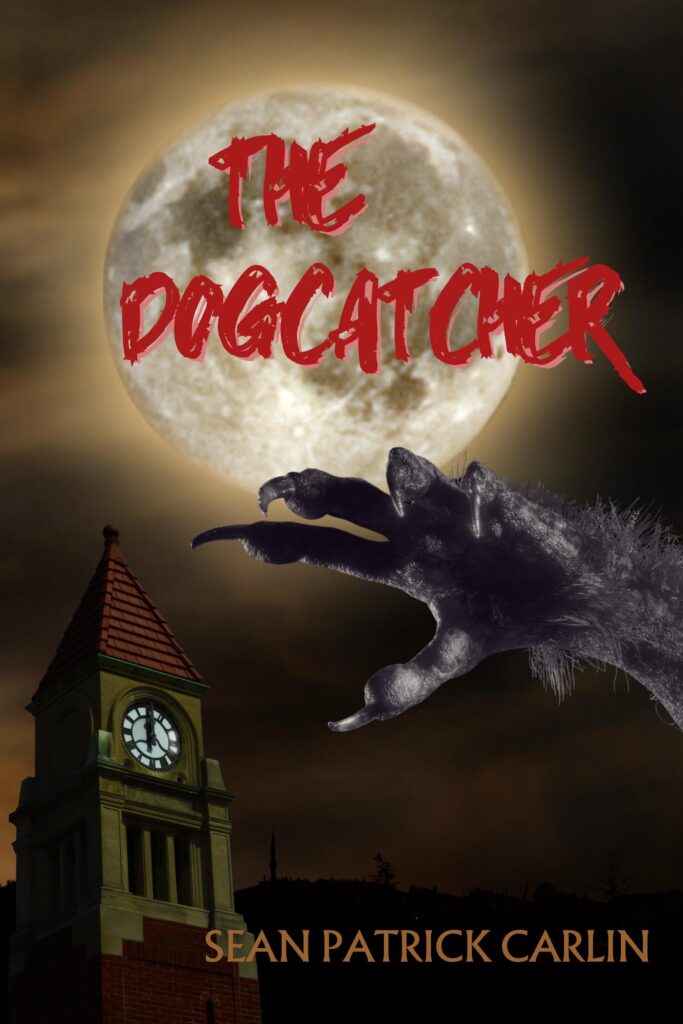
My first novel, The Dogcatcher, is now available from DarkWinter Press. It’s an occult horror/dark comedy about a municipal animal-control officer whose Upstate New York community is being terrorized by a creature in the woods. Here’s a (spoiler-free) behind-the-scenes account of the project’s creative inception and development; how it’s responsible for my being blackballed in Hollywood; how the coronavirus pandemic challenged and ultimately elevated the story’s thematic ambitions; and how these characters hounded my imagination—forgive the pun—for no fewer than fourteen years.
The Dogcatcheris on sale in paperback and Kindle formats via Amazon.
In the spring of 2007, I came home from L.A. for a week to attend my sister’s graduation at Cornell University. My first occasion to sojourn in the Finger Lakes region, I took the opportunity to stay in Downtown Ithaca, tour the Cornell campus, visit Buttermilk Falls State Park. I was completely taken with the area’s scenic beauty and thought it would make the perfect location for a screenplay. Only trouble was, all I had was a setting in search of a story.
CUT TO: TWO YEARS LATER
Binge-watching wasn’t yet an institutionalized practice, but DVD-by-mail was surging, and my wife and I were, as such, working our way through The X-Files (1993–2002) from the beginning. Though I have ethical reservations about Chris Carter’s hugely popular sci-fi series, I admired the creative fecundity of its monster-of-the-week procedural format, which allowed for the protagonists, his-and-her FBI agents Mulder and Scully, to investigate purported attacks by mutants and shapeshifters in every corner of the United States, from bustling cities to backwater burgs: the Jersey Devil in Atlantic City (“The Jersey Devil”); a wolf-creature in Browning, Montana (“Shapes”); a prehistoric plesiosaur in Millikan, Georgia (“Quagmire”); El Chupacabra in Fresno, California (“El Mundo Gira”); the Mothman in Leon County, Florida (“Detour”); a giant praying mantis in Oak Brook, Illinois (“Folie à Deux”); a human bat in Burley, Idaho (“Patience”).
Special Agents Fox Mulder (David Duchovny) and Dana Scully (Gillian Anderson) in “The X-Files”
But the very premise of The X-Files stipulated that merely two underfunded federal agents, out of approximately 35,000 at the Bureau, were appropriated to investigate such anomalous urban legends. I wondered: If an average American town found itself bedeviled by a predatory cryptid—in real life, I mean—would the FBI really be the first responders? Doubtful. But who would? The county police? The National Guard? If, say, a sasquatch went on a rampage, which regional public office would be the most well-equipped to deal with it…?
That’s when it occurred to me: Animal Control.
And when I considered all the cultural associations we have with the word dogcatcher—“You couldn’t get elected dogcatcher in this town”—I knew I had my hero: a civil servant who is the butt of everyone’s easy jokes, but whose specialized skills and tools and, ultimately, compassion are what save the day.
But it was, to be sure, a hell of a long road from that moment of inspiration to this:
When the basic concept was first devised, I wrote a 20-page story treatment for an early iteration of The Dogcatcher, dated August 25, 2009. That same summer, I signed with new literary managers, who immediately wanted a summary of all the projects I’d been working on. Among other synopses and screenplays, I sent them the Dogcatcher treatment.
They hated it. They argued against the viability of mixing horror and humor, this despite a long precedent for such an incongruous tonal marriage in commercially successful and culturally influential movies the likes of An American Werewolf in London (1981), Ghostbusters (1984), Gremlins (1984), The Lost Boys (1987), Tremors (1990), Scream (1996), and Shaun of the Dead (2004), to say nothing of then–It Girl Megan Fox’s just-released succubus satire Jennifer’s Body (2009). (I knew better than to cite seventy-year-old antecedents such as The Cat and the Canary and Hold That Ghost; Hollywood execs have little awareness of films that predate their own lifetimes.) I was passionate about The Dogcatcher, but it was only one of several prospective projects I was ready to develop, so, on the advice of my new management, I put it in a drawer and moved on to other things.
With road-trip season upon us once again, here’s an examination of how American car culture has been romanticized by the entertainment industry; how automobiles, far from enablers of freedom and individuality, are in fact “turbo-boosted engines of inequality”; and how Hollywood can help remedy an ecocultural crisis it’s played no small role in propagating.
In any given episode, the action reliably starts the same way: a wide shot of the Batcave, Batmobile turning on its rotating platform to face the cavemouth, camera panning left as the Dynamic Duo descend the Batpoles. Satin capes billowing, Batman and Robin hop into their modified 1955 Lincoln Futura, buckle up—decades before it was legally required, incidentally—and the engine whines to life as they run through their pre-launch checklist:
ROBIN:  Atomic batteries to power.  Turbines to speed.

BATMAN:  Roger.  Ready to move out.
A blast of flame from the car’s rear thruster—whoosh!—and off they’d race to save the day.
By the time the 1980s had rolled around, when I was first watching Batman (1966–1968) in syndicated reruns, every TV and movie hero worth his salt got around the city in a conspicuously slick set of wheels. Muscle cars proved popular with working-class ’70s sleuths Jim Rockford (Pontiac Firebird) and Starsky and Hutch (Ford Gran Torino). The neon-chic aesthetic of Reagan era, however, called for something a bit sportier, like the Ferrari, the prestige ride of choice for Honolulu-based gumshoe Thomas Magnum (Magnum, P.I.) and buddy cops Crockett and Tubbs (Miami Vice). The ’80s were nothing if not ostentatiously aspirational.
Even when cars were patently comical, they came off as cool despite themselves: the Bluesmobile, the 1974 Dodge Monaco used in The Blues Brothers (1980); the Ectomobile, the 1959 Cadillac Miller-Meteor Sentinel in Ghostbusters (1984); the Wolfmobile, a refurbished bread truck that Michael J. Fox and his pal use for “urban surfing” in Teen Wolf (1985).
The DMC DeLorean time machine from Back to the Future is clearly meant to be absurd, designed in the same kitchen-sink spirit as the Wagon Queen Family Truckster from National Lampoon’s Vacation (1983), but what nine-year-old boy in 1985 didn’t want to be Michael J. Fox, sliding across the stainless-steel hood and yanking the gull-wing door shut behind him? And like the characters themselves, the DeLorean evolved with each movie, going from nuclear-powered sports car (Part I) to cold-fusion flyer (Part II) to steampunk-retrofitted railcar (Part III). “Maverick” Mitchell’s need for speed didn’t hold a candle to Marty McFly’s, who’s very existence depended on the DeLorean’s capacity to reach 88 miles per hour.
Vehicles that carried teams of heroes offered their own vicarious pleasure. Case in point: the 1983 GMC Vandura, with its red stripe and rooftop spoiler, that served as the A-Team’s transpo and unofficial HQ—a place where they could bicker comically one minute then emerge through the sunroof the next to spray indiscriminate gunfire from their AK-47s. The van even had a little “sibling”: the Chevrolet Corvette (C4) that Faceman would occasionally drive, marked with the same diagonal stripe. Did it make sense for wanted fugitives to cruise L.A. in such a distinct set of wheels? Not really. But it was cool as hell, so.
The Mystery Machine was the only recurring location, as it were, on Scooby-Doo, Where Are You! (1969), and the van’s groovy paint scheme provided contrast with the series’ gloomy visuals. Speaking of animated adventures, when once-ascetic Vietnam vet John Rambo made the intuitive leap from R-rated action movies to after-school cartoon series (1986), he was furnished with Defender, a 6×6 assault jeep. Not to be outdone, the most popular military-themed animated franchise of the ’80s, G.I. Joe: A Real American Hero (1983–1986), featured over 250 discrete vehicles, and the characters that drove them were, for the most part, an afterthought:
With the debut of the 3 ¾” figures in 1982, Hasbro also offered a range of vehicles and playsets for use with them. In actual fact, the 3 ¾” line was conceived as a way to primarily sell vehicles—the figures were only there to fill them out!
But who needs drivers when the vehicles themselves are the characters? The protagonists of The Transformers (1984–1987) were known as the Autobots, a race of ancient, sentient robots from a distant planet that conveniently shapeshifted into 1980s-specific cars like the Porsche 924 and Lamborghini Countach, among scores of others. (The premise was so deliriously toyetic, it never occurred to us to question the logic of it.) Offering the best of both G.I. Joe and The Transformers, the paramilitary task force of M.A.S.K. (1985–1986), whose base of operations was a mountainside gas station (what might be described as Blofeld’s volcano lair meets the Boar’s Nest), drove armored vehicles that transformed into… entirely different vehicles.
Many movies and shows not only featured cars as prominent narrative elements, but literally took place on the road: Vacation. Mad Max (1979). Smokey and the Bandit (1977). CHiPs (1977–1983). Sometimes the car was so important it had a proper name: General Lee from The Dukes of Hazzard (1979–1985). Christ, sometimes it was the goddamn series costar: KITT on Knight Rider (1982–1986). Shit on David Hasselhoff’s acting ability all you want, but the man carried a hit TV show delivering the lion’s share of his dialogue to a dashboard. Get fucked, Olivier.
1980s hero-car culture at a glance
As a rule, productions keep multiple replicas of key picture cars on hand, often for different purposes: the vehicle utilized for dialogue scenes isn’t the one rigged for stunts, for instance. It’s notable that the most detailed production model—the one featured in medium shots and closeups, in which the actors perform their scenes—is known as the “hero car.” And why not? Over the past half century, Hollywood has unquestionably programmed all of us to recognize the heroism of the automobile.
A cultural blip, disowned and dismissed. A cultural phenomenon, nurtured and celebrated. Is there any doubt Kristy Swanson’s Buffy the Vampire Slayer is an Xer, and Sarah Michelle Gellar’s a Millennial?
Joss Whedon famously dislikes the movie made from his original screenplay for Buffy the Vampire Slayer (1992), directed by Fran Rubel Kuzui and starring Kristy Swanson. Seems he’d envisioned a B-movie with a Shakespearean soul, whereas Kuzui saw pure juvenile camp—an empowerment tale for prepubescent girls.
Buffy arrived right before it became cool for teenagers to brood about real things like depression and the cost of Doc Martens. But something about this particular movie was bewitching to a tweeny bopper with an alternative undertow. It had gloss and edge—but more gloss than edge. This was a pre-Clueless, Skittles-tinted ode to California ditz. . . . The result was an unfussy pre–Spice Girls girl-power fantasy for a 12-year-old kid.
Only a modest success during its theatrical run, the cult horror/comedy found an appreciable audience on VHS. Three years later, nascent netlet The WB saw an opportunity to bring the inspired concept of Valley girl–turned–vampire slayer to television—only this time under the auspices of the IP’s disgruntled creator:
Building on his original premise, he re-imagined the monsters as metaphors for the horrors of adolescence. In one climactic scene, Buffy loses her virginity to a vampire who has been cursed with a soul; the next morning, his soul is gone and he’s lusting for blood. Any young woman who had gone to bed with a seemingly nice guy only to wake up with an asshole could relate. . . .
In those early days of the internet, before nerd culture swallowed the world, fans flocked to a message board set up by the WB to analyze Buffy with the obsessive zeal of Talmudic scholars. Whedon knew how to talk to these people—he was one of them. He would visit the board at all hours to complain about his grueling schedule or to argue with fans about their interpretations of his work. Back then, as he pointed out to me, the internet was “a friendly place,” and he, the quick-witted prince of nerds, “had the advantage of it.”
It is impossible to fully appreciate the monopolistic stranglehold geek interests have maintained on our culture over the first two decades of this millennium without acknowledging the pivotal role Buffy the Vampire Slayer (1997–2003) played in elevating such pulp ephemera to a place of mainstream legitimacy and critical respectability. It was the right premise (Whedon pitched it as My So-Called Life meets The X-Files) on the right network (one willing to try new ideas and exercise patience as they found an audience) by the right creator (a card-carrying, self-professed geek) speaking to the right audience (impressionable Millennials) at the right time (the dawn of the Digital Age). It all synthesized at exactly that moment. Forget Booger—Buffy was our culture’s revenge of the nerds.
Sarah Michelle Gellar and Joss Whedon on the set of “Buffy the Vampire Slayer”
In what was surely a first for any geek or screenwriter, let alone a combo platter, a cult of hero worship coalesced around Whedon. His genius was celebrated on message boards and at academic conferences, inked in books and on body parts. “He was a celebrity showrunner before anyone cared who ran shows” (ibid.).
Master storyteller that he is, Whedon didn’t merely reset the narrative ofBuffy; he reframed the narrative about it. While serving as a loose sequel to the feature film, the television series wasn’t Buffy the Vampire Slayer 2 so much as Buffy the Vampire Slayer 2.0—a complete overhaul and upgrade. This was Buffy as it was always intended to be, before Hollywood fucked up a great thing. That the startup-network show emerged as a phoenix from the ashes of a major-studio feature only burnished Whedon’s geek-underdog credentials. To utter the word “Buffy” was to be speaking unambiguously about the series, not the movie.
What movie?
In 1997, Whedon premiered his Buffy series on The WB and essentially wiped the film from the collective memory.
By that point, I had turned 17, and even though the show was more serious than the movie, even though its universe was cleverer and more cohesive, even though the silent episode “Hush” was probably one of the best things on television at the time it aired, Buffy was still a vampire show—to me, it was just kids’ play. My adolescence adhered to a kind of Gen-X aimlessness, to indie films with lots of character and very little plot. Whedon’s show seemed more like the kind of thing Reality Bites would make fun of—a juvenile, overly earnest studio product.
As a member of Ms. Roberts’ demographic cohort, four years her senior, I’ll second that appraisal. Yet for the Millennials who came of age in a post-Whedon world, and who were introduced to Buffy through the series—who fell in love with her on TV—Whedon’s creative contextualization of the movie became the universally accepted, unchallenged, and perennially reinforced perception of it:
You actually can’t watch the Buffy the Vampire Slayer film online, and honestly, you might be better off. Luckily, all seven seasons of the Whedon-helmed (and approved) masterpiece that is Buffy the Vampire Slayer the series is easily streamed. 25 years later, Buffy movie is proof that our heroine was always better off in the hands of her maker.
The simultaneous display of blind devotion, proprietary entitlement, and self-assured dismissiveness in a statement like that, far from the only likeminded Millennial assessment of Buffy, is the kind of thing we humble Xers have spent a lifetime swallowing and shrugging off, even—especially—when we know better. Not that anyone much cares what we have to say:
Here’s a refresher on the measliness of Generation X: Our parents were typically members of the Silent Generation, that cohort born between 1928 and 1945—people shaped by the Great Depression and World War II, people who didn’t get to choose what they were having for dinner and made sure their kids didn’t either. The parents of Gen X believed in spanking and borderline benign neglect, in contrast to the boisterous boomers and their deluxe offspring, the millennial horde. . . .
. . . Baby boomers and millennials have always had a finely tuned sense of how important they are. Gen Xers are under no such illusion. Temperamentally prepared to be criticized and undermined at all times, we never entirely trusted the people in charge anyway.
Whereas the Millennials who deified Whedon have in recent years had to square their enduring love for Buffy with the spate of damning accusations against him—marital infidelity, feminist hypocrisy, emotionally abusive treatment of subordinates—the geek god’s fall from grace is no skin off Gen X’s nose; Big Daddy disavowed our Buffy, to the extent we feel that strongly about it one way or the other, decades ago. Lucky for us, as Ms. Paul observes, we never entirely trusted the people in charge anyway. And since Whedon’s critique of the Buffy movie remains to this day the culturally enshrined view of it, perhaps that merits reconsideration, too?
For the past quarter century, the differences between the Buffy movie and TV series have been authoritatively chalked up to all the usual cinema-snobbery bullshit: tone and aesthetics and emotional depth and worldbuilding breadth. Wrong. The tonal disparity between the two Buffys has from the outset been greatly overstated. The gap between Swanson’s Buffy and Gellar’s is, at its heart, generational.
This article discusses plot details and scene specifics from Michael Mann’s film Heat (1995) and his novel Heat 2 (2022).
John Carpenter’s dystopian classic Escape from New York (1981), set in 1997, opens with an expository intertitle: “1988—The Crime Rate in the United States Rises Four Hundred Percent.” Though that grim prognostication amounted to an exaggeration, the issue itself had nonetheless become a big deal here in the real world by the early 1990s:
In 1993, the year President Clinton took office, violent crime struck nearly 11 million Americans, and an additional 32 million suffered thefts or burglaries. These staggering numbers put millions more in fear. They also choked the economic vitality out of entire neighborhoods.
Politically, crime had become one of the most divisive issues in the country. Republicans called for an ever more punitive “war on drugs,” while many Democrats offered little beyond nebulous calls to eliminate the “root causes” of crime.
Clinton’s response was the measurably effective (if still controversial) Violent Crime Control and Law Enforcement Act of 1994, otherwise known as the 1994 Crime Bill, coauthored by Joe Biden, the provisions of which—and this is just a sampling—added fifty new federal offenses, expanded capital punishment, led to the establishment of state sex-offender registries, and included the Federal Assault Weapons Ban (since expired) and the Violence Against Women Act.
It was an attempt to address a big issue in America at the time: Crime, particularly violent crime, had been rising for decades, starting in the 1960s but continuing, on and off, through the 1990s (in part due to the crack cocaine epidemic).
Politically, the legislation was also a chance for Democrats—including the recently elected president, Bill Clinton—to wrestle the issue of crime away from Republicans. Polling suggested Americans were very concerned about high crime back then. And especially after George H.W. Bush defeated Michael Dukakis in the 1988 presidential election in part by painting Dukakis as “soft on crime,” Democrats were acutely worried that Republicans were beating them on the issue.
Given the sociopolitical conditions of the era, it stands to reason—hell, it seems so obvious in hindsight—the 1990s would be a golden age of neo-noir crime cinema. The death of Michael Corleone, as it happens, signified a rebirth of the genre itself; Martin Scorsese countered the elegiac lethargy—that’s not a criticism—of Francis Ford Coppola’s The Godfather, Part III with the coke-fueled kineticism of Goodfellas (both 1990). Henry Hill shared none of Michael’s nagging reluctance about life in the Italian Mafia; he always wanted to be a gangster!
Reasoning that was probably true of audiences, too—as an author of horror stories, I certainly appreciate a healthy curiosity for the dark side—Hollywood offered vicarious trips into the criminal underworlds of Hell’s Kitchen, in Phil Joanou’s State of Grace (1990), and Harlem, in Mario Van Peebles’ New Jack City (1991), both of which feature undercover cops as major characters. So does Bill Duke’s Deep Cover (1992), about a police officer (Laurence Fishburne) posing as an L.A. drug dealer as part of a broader West Coast sting operation.
The line between cop and criminal, so clearly drawn in the action-comedies of the previous decade (Lethal Weapon, Beverly Hills Cop, Stakeout, Running Scared), was becoming subject to greater ambiguity. In no movie is that made more starkly apparent than Abel Ferrara’s Bad Lieutenant (1992), about a corrupt, hedonistic, drug-addicted, gambling-indebted, intentionally nameless New York cop (Harvey Keitel) investigating the rape of a nun in the vain hope it will somehow redeem his pervasive rottenness.
And it wasn’t merely that new stories were being told; this is Hollywood, after all, so we have some remakes in the mix. Classic crime thrillers were given contemporary makeovers, like Scorsese’s Cape Fear (1991), as well as Barbet Schroeder’s Kiss of Death (1995), which is mostly remembered, to the extent it’s remembered at all, as the beginning and end of David Caruso’s would-be movie career, but which is much better than its reputation, thanks in no small part to a sharp script by Richard Price (Clockers), full of memorably colorful Queens characters and his signature street-smart dialogue.
Creative experimentation was in full swing, too, as neo-noir films incorporated conventions of other genres, including erotic thriller (Paul Verhoeven’s Basic Instinct [1992]), black comedy (the Coen brothers’ Fargo [1996] and The Big Lebowski [1998]), period throwback (Carl Franklin’s Devil in a Blue Dress [1995]; Curtis Hanson’s L.A. Confidential [1997]), neo-Western (James Mangold’s Cop Land [1997]), and, well, total coffee-cup-shattering, head-in-a-box mindfuckery (Bryan Singer’s The Usual Suspects; David Fincher’s Seven [both 1995]).
Christ, at that point, Quentin Tarantino practically became a subgenre unto himself after the one-two punch of Reservoir Dogs (1992) and Pulp Fiction (1994), which in turn inspired an incessant succession of self-consciously “clever” knockoffs like John Herzfeld’s 2 Days in the Valley (1996) and Gary Fleder’s Things to Do in Denver When You’re Dead (1995). By the mid-’90s, the crime rate, at least at the cinema, sure seemed like it had risen by 400%.
Tim Roth lies bleeding as Harvey Keitel comes to his aid in a scene from the film “Reservoir Dogs,” 1992 (photo by Miramax/Getty Images)
As different as they all are, those films can almost unanimously be viewed as a repudiation of the ethos of ’80s action movies, in which there were objectively good guys, like John McClane, in conflict with objectively bad guys, like Hans Gruber, in a zero-sum battle for justice, for victory. It was all very simple and reassuring, in keeping with the archconservative, righteous-cowboy worldview of Ronald Reagan. And while those kinds of movies continued to find a receptive audience—look no further than the Die Hard–industrial complex, which begat Under Siege (1992) and Cliffhanger (1993) and Speed (1994), among scores of others—filmmakers were increasingly opting for multilayered antiheroes over white hats versus black hats.
Which begged the question: Given how blurred the lines had become between good guys and bad guys in crime cinema, could you ever go back to telling an earnest, old-school cops-and-robbers story—one with an unequivocally virtuous protagonist and nefarious antagonist—that nonetheless aspired to be something more dramatically credible, more psychologically nuanced, more thematically layered than a Steven Seagal star vehicle?
Since launching this blog eight years ago, I have maintained a consistent publishing schedule of one new post per month. However, given the ways in which this ongoing project has evolved, that level of output is no longer sustainable. Here’s a brief chronicle of the blog’s creative progression—and a statement on what comes next.
From the time I signed with my first literary manager in 1998 through the ignominious end of my career in Hollywood in 2014, I was exclusively focused on one form of creative expression: screenwriting.
Though ultimately unproduced, my scripts nonetheless earned praise from producers and development execs for their uncommon visual suggestiveness and sharp sense of pace, which I controlled through deliberate syntactic arrangement of the very things that do not appear in the finished film for audiences to appreciate: the stage description.
Screenwriters, if you’re unaware, are not by and large particularly skillful wordsmiths. And, to be fair, it’s not required of them. Plot structure, characterization, and dialogue are what the screenwriter is there to provide for a motion picture. Why waste time and creative energy on pretty prose in a blueprint, which is all a screenplay really is?
A rarified handful of pro screenwriters, Shane Black and James Cameron among them, paint immersive pictures with their words, imparting how the world of the story feels over merely sequentially reporting what happens. Such is the dynamic mode of screenwriting for which I strove.
Most screenplays—and I’m talking about scripts to produced films, written by Hollywood’s A-list scribes—aren’t much more than utilitarian laundry lists of things we’ll see and hear onscreen, conveyed without any visceral impression of style or tempo, and are, accordingly, nigh unreadable. The director, after all, is going to make the movie he sees in his head; the script is just a means to get all the above- and below-the-line talent quite literally on the same page.
Excerpted from “Indiana Jones and the Kingdom of the Crystal Skull” by David Koepp. Mind-numbing, no?
I actually like words, however. I like how they sound, and the infinite combinations of meaning that can be made from them. Truth is, I never should’ve aspired to be a screenwriter. It was the wrong medium for my talents and interests. “Author” and “essayist” were always a better fit for my writerly sensibilities. It took the implosion of my career to finally embrace that.
One year into this blogging project, all my notions about narrativity were challenged—perhaps even shattered—by a book I’d read called Present Shock: When Everything Happens Now (2013) by Douglas Rushkoff, which argued that Joseph Campbell’s “heroic journey,” the dramatic schema that has served as the structural basis for nearly every story in the Western literary canon, had collapsed around the turn of the millennium, as evidenced by the fanatical popularity of “storyless” fiction like Lost, The X-Files, The Sopranos, CSI: Crime Scene Investigation, The Walking Dead, and Game of Thrones.
Rushkoff’s premise inspired a yearslong scholarly investigation on my part, which began in earnest with a post called “Journey’s End: Rushkoff and the Collapse of Narrative,” and turned the blog in a new, more complex direction. This intellectual project would never be the same.


Recent Comments